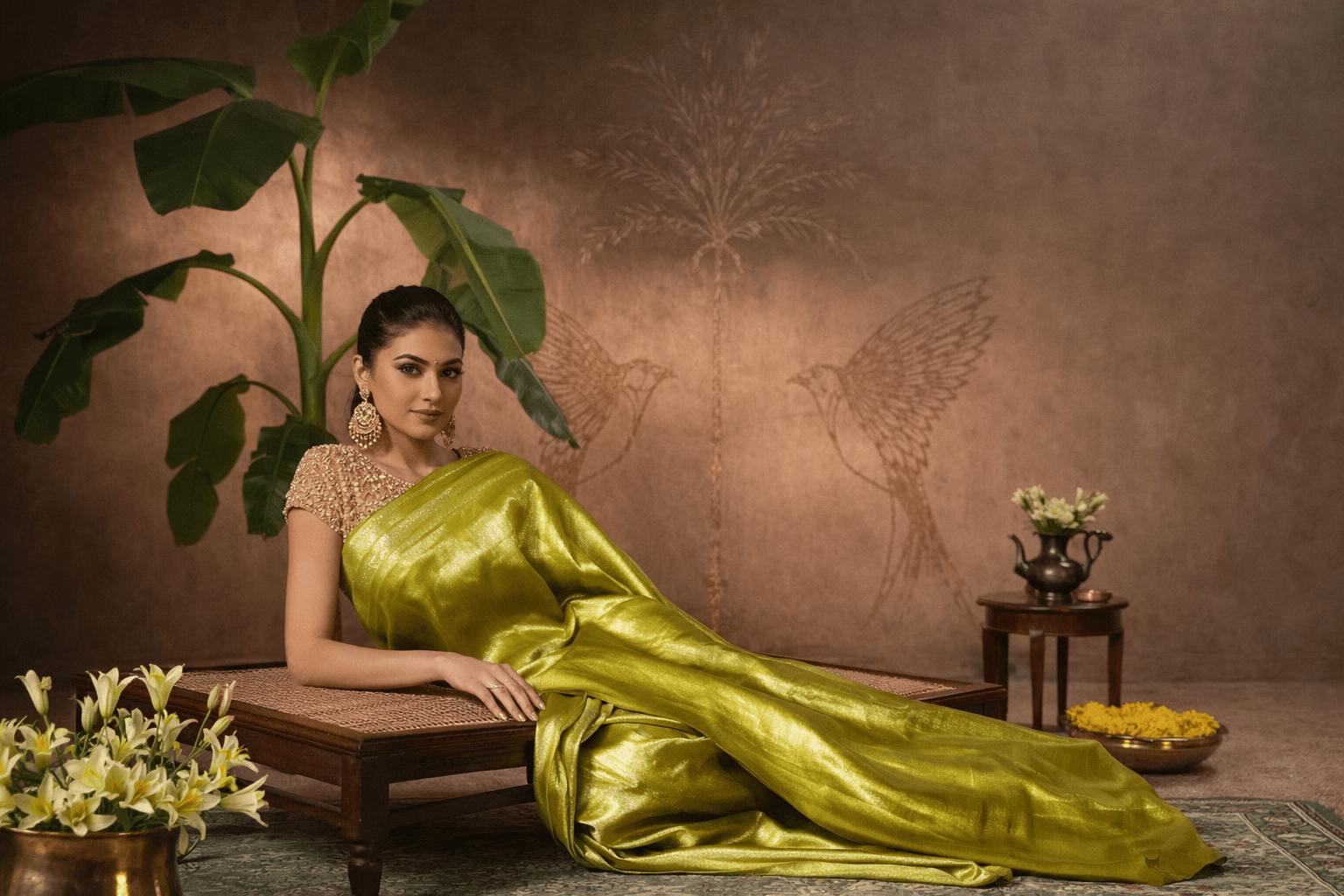
Article: How Does It Behave? The 2026 Banarasi Wedding Edit from the Store Floor
How Does It Behave? The 2026 Banarasi Wedding Edit from the Store Floor
In 2026, wedding dressing is less about a single showstopper and more about a wardrobe of decisions. The saree has to earn its place: it must move through a morning ceremony, survive a humid car ride, hold itself under harsh LED lighting, and still look like something you keep, not consume. On the store floor, the question isn’t “How heavy is it?” anymore. It’s “How does it behave?”
Because here’s the truth nobody admits out loud: most wedding sarees don’t fail on beauty. They fail on performance. They crease where they shouldn’t, slip when you stop thinking about them, collapse in photos, or feel like a beautiful compromise you can’t wait to take off.
A Banarasi, done right, does the opposite. It holds line. It holds memory. It holds you together.

The year of the lightweight statement
“Lightweight” doesn’t mean less bridal, less festive, or less serious. It means the saree has been designed with intelligence: the spacing is considered, the weave has breathability, the zari sits where it adds power instead of adding fatigue.
This is where people are getting sharper. They’re not shopping “a Banarasi.” They’re shopping a Banarasi for the exact hour of the day they intend to wear it. Morning pheras want air. Sangeet wants movement. Reception wants drama that still looks crisp at midnight.
Colour is going editorial
The 2026 palette is not one trend. It’s a wardrobe strategy.
Pastels are no longer “safe.” They are deliberate, chosen for daylight and clean photographs, for soft gold jewellery, for the kind of weddings where the décor is quiet and the clothes must speak in undertones. Jewel tones remain undefeated for evenings because they don’t flatten under artificial light and they carry ornamentation without looking crowded.
And then there’s the quietly luxury direction: champagne golds, softened browns, muted metallics, toned-down silvers. Quiet luxury, when done right, is a commitment to restraint, finish, and quality over obviousness. In Banarasi terms, it’s the saree that doesn’t shout its price. It simply refuses to look inexpensive.
The weave-first approach: match your Banarasi to your venue
The weave is not a detail. It’s the architecture.
If the venue is sunlit, humid, or outdoors, you want a Banarasi that stays legible in movement. If the venue is velvet-lit and late-night, you want a Banarasi that holds depth and doesn’t lose its shape after hours of sitting, standing, blessing, eating, and being photographed.
Katan belongs to summers too. Katan is a year-round classic; the weight and weave density decide whether it becomes your summer pick or your winter statement.
Organza and georgette are not “new,” but the way they’re being used is new. They’re being chosen for function first, and then styled into fashion. One gives you structure without weight; the other gives you ease without looking casual.
Zari is getting more intentional
This season isn’t about maximum zari. It’s about intelligent placement.
A strong border with breathing room can look more expensive than a fully packed layout, because the eye knows where to rest. Butis that don’t compete with each other photograph better. Negative space reads like confidence. And confidence, in wedding dressing, is always the most modern thing in the room.
The saree stays the hero, the blouse becomes the support system
In 2026, the blouse isn’t the headline. It’s the support system.
A good blouse quietly solves problems: it keeps the saree stable, it sits comfortably for long hours, it doesn’t snag zari, it doesn’t fight the border, it doesn’t demand attention every time you turn around. It lets the saree do what a Banarasi is meant to do: enter first, linger longest, and look effortless while doing it.
Care, but make it realistic
A wedding saree is worn once and stored for years, so storage is part of the purchase decision, whether you admit it or not. Breathable wrapping and avoiding plastic are common recommendations for preserving silk and zari over time. Refolding periodically helps prevent hard creases from setting in.