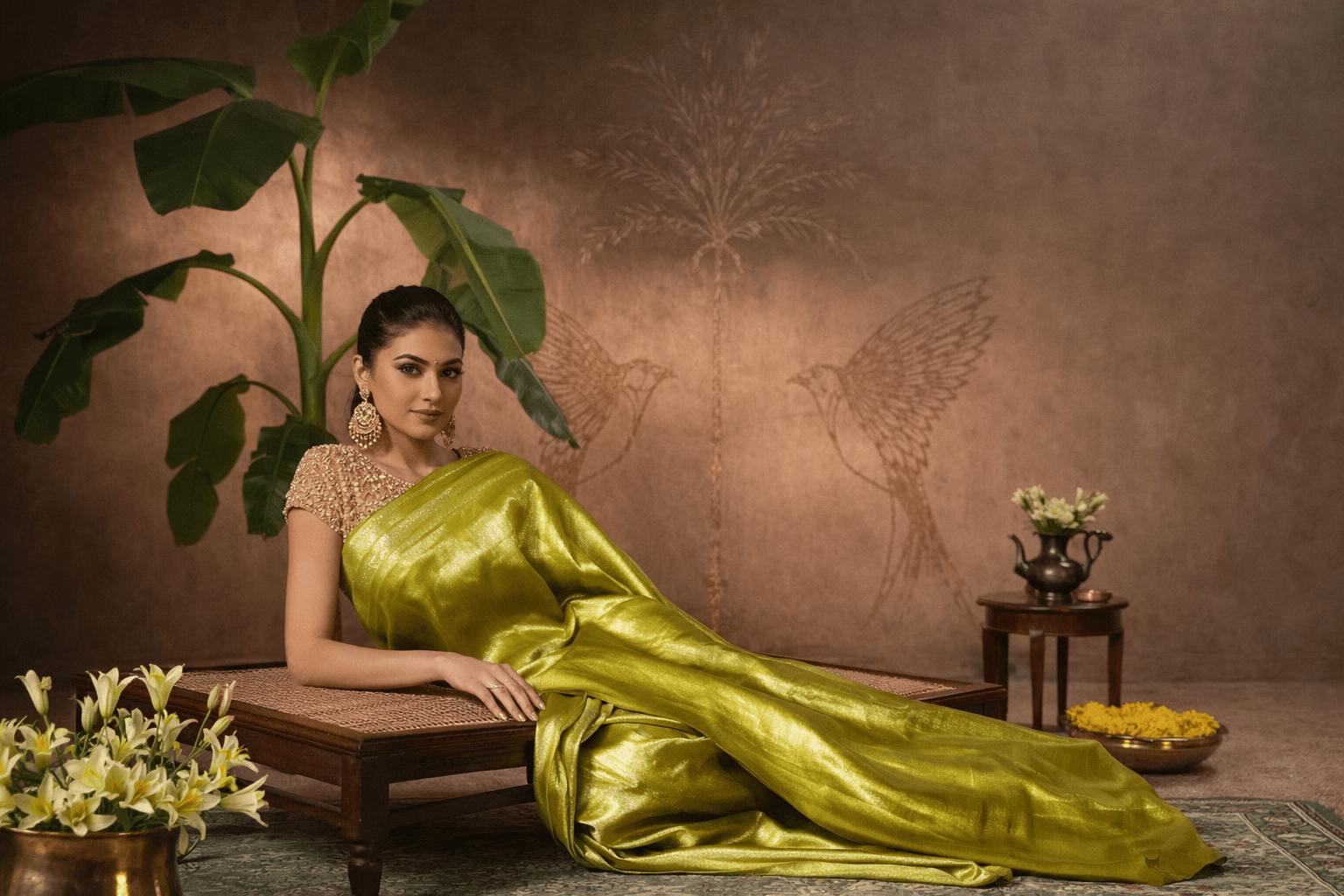
Reading a Banarasi: What Makes One Worth Keeping
Here's what nobody tells you when you're standing in front of ten red Banarasis that all look expensive: expensive doesn't always mean good. And good doesn't always hold up.
The difference between a Banarasi you wear once and forget and a Banarasi that becomes part of your story isn't always visible at first glance. But it's there. In the weight of the drape. In how the zari catches light. In whether the saree still looks like itself after a single wear, or whether it creases into something you'd rather not repeat.
This is about learning to read a Banarasi the way you'd read a person: not by what they announce, but by what they reveal when you pay attention.

The weave is the resume
Kadhua vs. cutwork
Kadhua is the traditional discontinuous supplementary weft technique. Each motif is individually woven, which means the zari threads don't run across the entire width of the saree - they appear only where the design calls for them. Turn a kadhua Banarasi to the reverse, and you'll see that the back is relatively clean, with motifs sitting on the surface rather than threads running loose everywhere.
Cutwork uses continuous threads that run the full width, and then the unwanted portions are cut away. The result? A heavier saree with loose zari threads on the reverse side. It's faster to produce, which is why it's more common. It's not necessarily inferior, but it behaves differently: more weight, less flexibility, and a tendency to fray over time if the loose threads aren't secured properly.
If the price feels too good and the back of the saree looks messy with floating threads, you're likely looking at cutwork being sold at kadhua prices.
What handloom actually means in 2026
'Handloom' has become shorthand for authenticity, but the reality is more textured. True handloom weaving is done entirely on a manual loom - no jacquard punch cards, no power assistance. The weaver controls the entire process, which means slight, beautiful inconsistencies: a motif that's not perfectly symmetrical, a border that breathes rather than marches in rigid uniformity.
But plenty of sarees labeled 'handloom' are woven on jacquard looms or semi-mechanized setups. This isn't inherently dishonest - it's a spectrum. The issue is when machine-made precision is sold as artisan inconsistency.
How to tell: Look at the edges of motifs. Handloom will show slight variation. Machine-made will repeat with factory-level exactness. Run your hand across the surface. Handloom has texture, even minor unevenness. Machine weaves feel almost too perfect.
Zari: the non-negotiable
Zari is where most buyers get taken. Because the difference between real zari and imitation is the difference between a saree that ages well and a saree that tarnishes, literally.
Pure zari vs. imitation zari
Real zari (also called pure zari or katan zari) is made of silk threads wrapped in metallic silver, often gold-plated. It's flexible, has a warm glow rather than a sharp shine, and it doesn't tarnish over time. It moves with the fabric.
Imitation zari is typically made of metallized polyester or plastic film. It's stiffer, shinier in a cooler, more reflective way, and over time - especially with improper storage - it can oxidize, blacken, or peel.
The tests you can actually do
The magnet test: Real zari won't react to a magnet because it's wrapped around silk. Imitation zari often has a metallic core and will be slightly attracted to a strong magnet. This test isn't foolproof - some high-quality imitations won't react either - but it's a quick indicator.
The burn test: This one's definitive but requires sacrificing a tiny bit of fringe or loose thread. Pure zari, being silk-based, burns slowly and smells like burnt hair. Imitation zari, being plastic-based, melts quickly, forms a hard bead, and smells like burning plastic. If you're investing serious money, ask the seller if you can perform this test. A refusal is information.
The visual tell: Look at how the zari reflects light. Real zari has a softer, warmer glow that changes depending on the angle. Imitation zari has a harsher, more uniform shine - it almost looks wet under certain lighting.
And here's the thing people don't say out loud: not all imitation zari is bad. Some high-quality metallized threads photograph beautifully and hold up well if cared for properly. The problem is when it's sold at pure zari prices. Know what you're paying for.
Silk quality: not all katan is created equal
The base fabric matters as much as the embellishment. A Banarasi is only as good as the silk it's built on.
What to feel for
Good silk has a subtle crispness to it - a body that holds shape without feeling stiff. When you drape it, it should fall in clean lines, not collapse limply or stand up rigidly.
Run your palm across the surface. High-quality silk has a cool, smooth hand-feel with a faint natural sheen. Lower-grade silk can feel slightly coarse or overly slippery (a sign of excessive processing or synthetic blending).
Check the weave density by holding the saree up to light. A tighter weave means the fabric is less likely to snag, pill, or lose its structure after a few wears. If you can see significant gaps between threads, the saree may not age well.
The blended silk question
Silk-cotton blends, silk-viscose blends, and silk-polyester blends are everywhere now. Sometimes they're great - lighter, more breathable, easier to maintain. Sometimes they're a way to stretch expensive silk with cheaper fibers and still charge premium prices.
The key is transparency. If a saree is blended, it should be disclosed and priced accordingly. Pure silk has a certification mark in India (Silk Mark), but not all sellers use it. If you're told it's 'pure silk,' ask which type of silk and whether it's certified. Hesitation is a red flag.
Design density: when more becomes less
There's a common misconception that heavier zari work equals better Banarasi. It doesn't. What matters is intentional design.
A saree that's entirely covered in zari can look expensive in pictures and exhausting in person. It photographs well but wears heavy, feels stiff, and often flattens the visual impact because the eye has nowhere to rest.
The best Banarasis understand negative space. A strong border with a clean field. Butis that are placed with rhythm, not crowded. Motifs that create a visual hierarchy rather than competing for attention.
This is why vintage Banarasis often look more sophisticated than newer ones - they were woven in an era when restraint was still considered a mark of refinement. Modern tastes lean heavier, but 'more' isn't always 'better.' It's just louder.
Price-to-quality markers: what you should be paying for
Pricing in the Banarasi market is wildly inconsistent, which makes it easy to overpay or undervalue. Here's what actually justifies a higher price:
Kadhua weave with pure zari: This is the gold standard. It's slower to produce, requires skilled labor, and uses expensive materials. If a saree checks both these boxes, a premium price makes sense.
True handloom with visible artisan inconsistency: If the weave shows the hand of the maker - slight variations that prove human input - you're paying for craft, not just product.
High-quality silk with tight weave density: Silk quality varies dramatically. A saree made from finer silk threads with a denser weave will cost more to produce and will last significantly longer.
What doesn't justify a premium: Brand name alone. Excessive zari that adds weight but not elegance. Marketing language like 'royal' or 'heritage' without proof of weaving technique. Packaging that costs more than the saree's actual material quality.
The saree you keep vs. the saree you regret
Here's the distinction that matters: a Banarasi worth keeping is one you can wear more than once without it losing its story.
It doesn't crease in ways you can't fix. It doesn't lose its shape after a six-hour wedding. The zari doesn't tarnish in storage. The silk doesn't snag on jewellery or rough surfaces. The design doesn't look dated three years later because it was never trying to be trendy in the first place.
And most importantly: you don't feel like you're wearing someone else's idea of what a Banarasi should be. You feel like you made a choice that was yours, informed, intentional.
That's the difference. Not whether the saree is expensive. Whether it's worth it.